In short
Bioenergy is energy from plants, wood, manure or waste. The label "green" fits one source and not another. Sawdust, wood residues, manure and used cooking oil are suitable raw materials. Whole trees and food crops are less suitable. A wood stove emits far more fine particles than a gas boiler or a heat pump, and a pellet stove probably also emits more than those two. Whether wood is "CO2-neutral" depends on the time the forest needs. "Green gas" in your contract is a certificate, not a separate gas in your pipe. If you replace a gas or oil boiler, first check whether a heat pump is possible.
What you hear: what is true?
| What you hear | Is it true? | Why |
|---|---|---|
| "Pellets are CO2-neutral." | It depends | For sawdust and wood residues almost, for whole trees it can take decades to hundreds of years. |
| "A pellet stove gives off no extra CO2, the tree absorbed it first." | False | Per kWh of fuel, the chimney emits about twice as much CO2 as a gas boiler. Whether the forest takes it back, and how fast, depends on the raw material. |
| "Burning wood is natural and therefore healthy." | False | Wood smoke contains fine particles and PAHs, and the VMM (Vlaamse Milieumaatschappij, the Flemish Environment Agency) calls PAHs carcinogenic. |
| "Biogas from waste is always green." | Partly true | Waste is a suitable raw material, but methane leaks can shrink the gain. |
| "Biofuel in the tank is better for the climate." | It depends | Waste oil usually yes, palm oil no. For food crops it depends on land use. At the pump, you do not choose this yourself. |
| "A pellet stove is greener than a heat pump." | It depends | If you count the CO2 of wood as zero, they are of the same order of magnitude. On fine particles, the heat pump wins clearly. |
What is biomass?
Biomass is everything that comes from plants, trees or animals and serves as fuel. Firewood, pellets, manure, garden waste, cooking oil and maize are examples. Biogas, bioethanol and biodiesel are fuels made from biomass.
The CO2 from biomass is called biogenic CO2. Fossil CO2 comes from oil, coal or natural gas. These lay underground for millions of years.
Is wood CO2-neutral?
What the accounting says
The UN climate rules (IPCC guidelines of 2006) do not count the CO2 of burnt wood under energy. Countries report it under land use and forests (the AFOLU sector). That way a country does not count the same CO2 twice. This is an accounting agreement. The atmosphere does not follow it: CO2 from wood warms the air just as much as CO2 from gas.
What nature does
Burning wood releases its CO2 within hours. A forest takes it back up over decades to hundreds of years. That depends on the type of wood and on what happens to the forest after the harvest. For that whole time, extra CO2 is in the air. The European science academies (EASAC) compare this to a loan (a carbon debt) that the forest repays later. With whole trees, that loan is large.
The American study by Sterman and colleagues (Environmental Research Letters, 2018) worked this out for forests in the eastern US. The carbon debt lasts 44 to 104 years after clear-cutting, depending on the forest type. In that calculation the land stays forest and wood replaces coal in a power plant. The authors warn that the debt gets larger if wood replaces natural gas. Natural gas emits less CO2 per kWh than coal (IPCC figures).
Where the critics and the defenders are right
The critics are right that "wood is always neutral" is too simple. EASAC writes that repayment can take decades to hundreds of years and that the climate suffers in the meantime. The JRC, the research service of the European Commission, also saw a gap in 2021 between the reported harvest and the reported use of wood. The harvest seems to be underestimated. According to the JRC, that gap may be caused by the energy sector.
The defenders are right about residues. EASAC says that energy from waste and thinnings can be CO2-neutral or better after a short time. Sawdust from a sawmill would otherwise rot, and then its CO2 is released too. So what counts is the time and the raw material, not the word "wood".
What Europe requires
The European Renewable Energy Directive (RED III, Directive (EU) 2023/2413) sets stricter rules for forest biomass: no harvest in primary forests or on peatland, and limits on large clear-cuts. The sustainability rules and the greenhouse gas saving rules apply to installations of 7.5 MW thermal capacity and above for solid biomass. Your stove or boiler at home does not fall under them. For pellets in your own stove, the directive therefore requires no check on origin.
Pellets and wood heating at home
What the ENplus label says
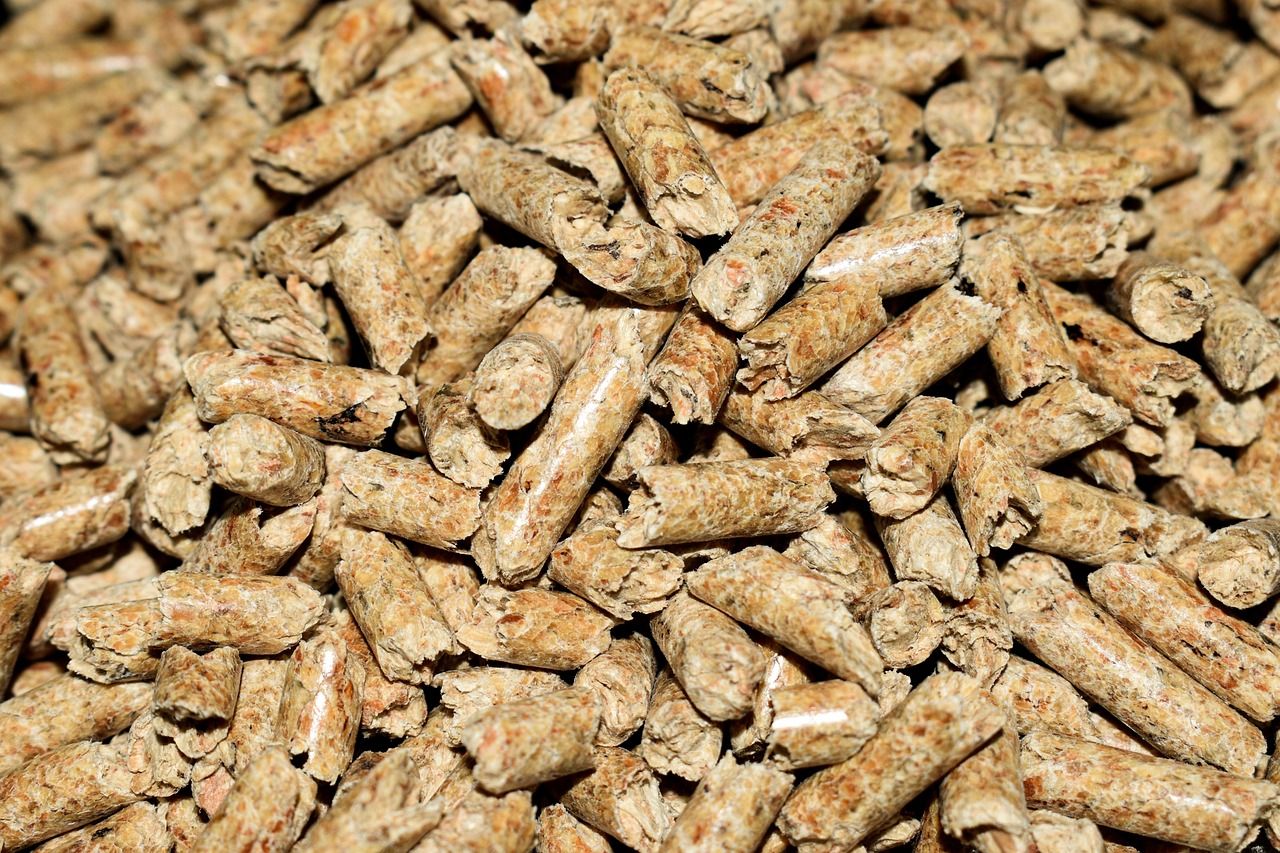
ENplus is a quality label for pellets, managed by the European Pellet Council, the organisation of the pellet industry. The label tests the pellet itself: for class A1, at most 0.7% ash and at least 4.6 kWh per kg. For A1 the label also allows stem wood, not only residues. This is in the ENplus handbook (2015 version). So ENplus says something about the quality of the pellet, not about the forest. If you want more certainty about origin, ask for pellets made from sawdust or for a forest management label such as PEFC or FSC.
What comes out of the chimney
The table shows the emissions in the home. For the heat pump, the emissions from power generation count.
| Heating | CO2 per kWh of fuel | Fine particles (PM2.5) per kWh of fuel | Note |
|---|---|---|---|
| Gas boiler | 202 g | about 0.1 mg | fossil |
| Oil boiler | 267 g | about 3 mg | fossil |
| Wood in German households (average) | 403 g | about 185 mg | biogenic CO2, all appliances together |
| Pellet stove or boiler | 403 g | no comparable figure found | biogenic CO2 |
| Heat pump | 131 to 185 g per kWh of electricity, so 33 to 66 g per kWh of heat | no emissions in the home | CO2 at the power plant, including the chain |
PM2.5 is fine particles smaller than 2.5 micrometres that reach deep into the lungs. The CO2 figures come from the IPCC default values for households, converted to kWh of fuel. The fine particles come from the German national inventory (UBA, the German Environment Agency, 2026), measured without the parts that only condense in the air. The absolute figures are therefore probably too low. The ratio is clear, though: wood emits many times what a gas boiler emits. The inventory gives no figure for pellets. Pellet stoves must meet stricter limits than wood stoves (see below). A pellet figure that can be compared with gas is missing, so the comparison of pellets with gas is indicative.
For Belgian electricity the table uses two sources, because they differ. The Université de Liège (technical report, 2026, not peer reviewed) arrives at 131 g per kWh in 2025, based on Elia (the high-voltage grid operator). Electricity Maps (2025) arrives at 185 g, using a different method. For the seasonal efficiency of the heat pump (kWh of heat per kWh of electricity over a year) the table uses 2.8 to 4.0, with about 3 as the central value. The 2.8 is the median of a British trial of air-source heat pumps in homes (Energy Systems Catapult, 2023). Fraunhofer ISE measured an average of 3.4 in 61 air-to-water systems in Germany. The 4.0 is a catalogue value from laboratory measurements, so a value on paper. In the tests of Test-Aankoop (the consumer organisation) the lowest seasonal efficiency is 2.3 and the average is just above 3. Belgian field measurements were not found. Divided by 2.8 to 4.0, that gives 33 to 66 g per kWh of heat (131 divided by 4.0 is 32.75 g, 185 divided by 2.8 is 66.07 g). At an efficiency of about 3, it is 44 to 62 g. The calculation is indicative. For gas, oil and wood, the table shows only the chimney, without the chain.
If you count the CO2 of wood as zero, about 18 g per kWh remains for the chain, according to Energie-Atlas Bayern (a German state website, with no year or source). This figure has not been independently checked. It is lower than the 33 to 66 g of the heat pump. That is why the table at the top says "it depends" and not "false". The discussion is about that accounting zero.
What the rules are
According to the VMM, heating of buildings, especially wood burning, is the main source of primary fine particles in Flanders. The VRT (the Flemish public broadcaster) wrote in 2024 that roughly 600,000 households in Flanders use a wood stove as main or extra heating (an estimate). Few rules apply to your own stove (status according to the VRT, 2024 and February 2026). A new Flemish rule for 2026 was not found.
- You may only burn clean, untreated wood, not waste wood. Nobody checks this.
- New appliances must meet the European ecodesign requirements. Since 1 January 2022, a limit of 20 mg of fine particles per m³ of flue gas applies to closed pellet stoves and 40 mg per m³ to closed wood stoves.
- There is no duty to register a stove and no general rule on the position or height of the chimney. Municipalities can make their own rules.
- At the information threshold of 35 µg/m³ PM2.5 (24-hour rolling average), the VMM asks you not to burn wood. This is advice, not a ban.
According to the VRT, a VMM report of December 2025 says that the emissions of new appliances are probably underestimated. For anyone who still wants to burn wood, the VMM recommends an automatically controlled pellet stove rather than a wood stove.
Grant and costs
Flanders gives no grant for a pellet boiler or pellet stove. This is on the Flanders page, which carries no date (viewed on 30 October 2026). A municipality or province may give one. Check this with the Premiezoeker (the grant finder). For a heat pump, Flemish support does exist. See the article "Heat pump: is your home ready?".
Pellets cost on average €6.75 per 15 kg bag in September 2026 (Test-Achats), so €0.45 per kg. According to the Test-Aankoop dossier, an average household needs about 4 tonnes a year. That costs around €1,800, plus a place to store the pellets. Per kWh of heat, that comes to 11 to 12 cents if your appliance reaches 80 to 90% efficiency (our own calculation, with 4.6 kWh per kg for ENplus A1). A heat pump with a seasonal efficiency of 2.8 to 4.0 costs the same to run if electricity costs 30 to 49 cents per kWh (our own calculation). Check on your bill what you pay now.
Biogas and green gas
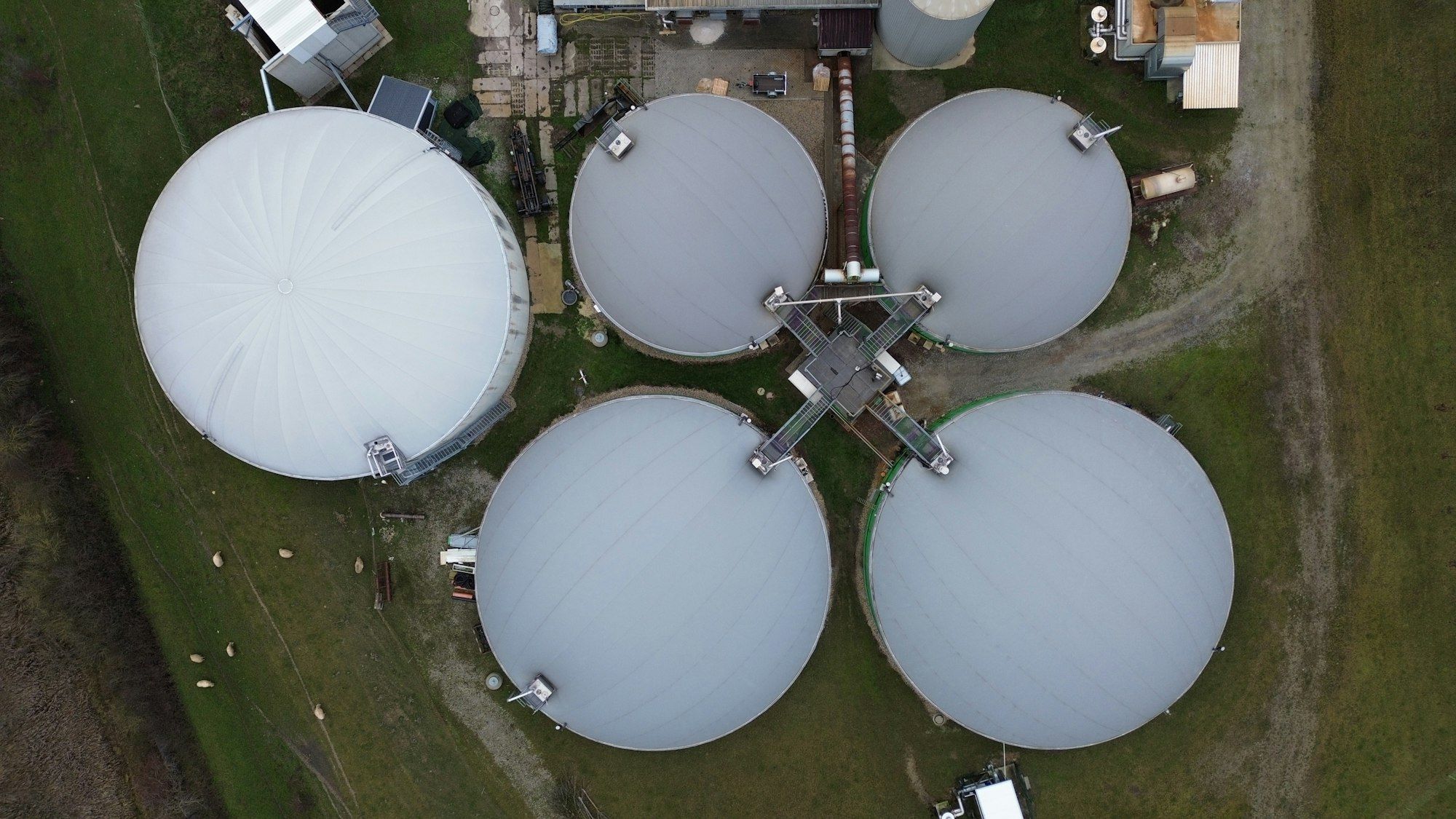
Biogas forms when bacteria break down manure, food scraps, sewage sludge or maize without oxygen. A plant cleans it into biomethane, which has the same quality as natural gas and can go into the gas grid. Aquafin (the Flemish wastewater company) and Fluvius (the Flemish distribution grid operator) plan to do this with sewage sludge: five treatment plants are to supply 40 GWh a year together, enough for 2,650 households (Fluvius, 14 October 2024, still a plan).
Manure and food waste also release methane without a plant, says the International Energy Agency (IEA). Maize needs a field that could also supply food. According to the IEA, Europe is shifting from energy crops to manure, residues and waste.
Methane is itself a strong greenhouse gas. If it leaks, the gain shrinks. The IEA (report of May 2025) cites measurements on whole plants: on average about 2.4% leaks from agricultural biogas and 7.5% from water treatment. Large plants leak about 2%, small and medium plants 5.5%. For comparison, the IEA cites 1.2% for oil and gas worldwide in 2024. According to the IEA, plants must store digestate (what is left after fermentation) in a closed tank, burn off residual gases and detect and repair leaks to keep the environmental gain.
What do you get when you buy green gas? Biomethane flows through the same natural gas grid as other gas (Fluvius). A guarantee of origin (GO) is a certificate that proves where the energy produced came from. For gas, this runs through Fluxys (the gas transmission grid operator). With a GO, a customer shows that its consumption is renewable. Aquafin sells its green gas certificates to companies, and that helps pay for the plant. So no separate green gas arrives in your pipe. Your boiler uses the gas from the grid. The certificate shows that a producer elsewhere made an equal amount of green gas. Ask your supplier which raw material is behind it.
Biofuels at the pump
E10 petrol contains up to 10% bioethanol. B7 diesel contains up to 7% biodiesel (standard EN 590, according to the FPS Economy). At the pump you also find B10, with up to 10% biodiesel. E10 has been at Belgian pumps since 1 January 2017. According to Febiac (the Belgian automotive federation, via Carbu, 2017), about 98% of petrol cars built from 2000 can use E10. For older cars, Super 98 is the advice. E10 contains a little less energy, so consumption rises slightly.
First-generation biofuels come from food crops such as maize, rapeseed or palm oil. For these crops, forest or grassland may disappear elsewhere. This is called indirect land use change (ILUC), and the CO2 released in the process can cancel the gain. The EU limits biofuels from food and feed crops to at most 7% of energy use in transport. The share of fuels with a high ILUC risk must be zero in 2030.
Palm oil is on that list at the EU. The European Parliament calls this "scientifically robust and undisputed" (resolution of 8 July 2026). Soy is disputed. On 10 April 2026 the Commission adopted a text that adds soy. On 8 July 2026 the Parliament objected, by 388 votes to 248. According to the Parliament, that text therefore cannot enter into force, and the Commission must put forward a new text. So soy is not on the list now. A new text from the Commission was not found. In Belgium, palm oil since 1 January 2023 and soy since 1 July 2023 no longer count towards the blending obligation. This is in a law of 16 December 2022, as the minister explained to the Chamber committee in 2023. The bill contains exceptions for waste raw materials and for fuels with a low-ILUC-risk certificate. The text in the Belgian Official Gazette was not checked.
Biofuels from waste and residues, such as used cooking oil and animal fat, are often better for the climate. For those two, the EU rules count at most 1.7% of the energy in transport. Belgium still has to transpose the new European rules for transport (RED III) into Belgian law. An official source on the state of that transposition was not found.
Where bioenergy fits
According to the sources in this article, bioenergy fits best with waste and residues that exist anyway: sawdust, manure, sewage sludge, used cooking oil. It is also often mentioned for industrial heat, where electric heating is hard. It fits less well with whole trees and with crops that displace food or land. In a home where a heat pump is possible, burning wood, with the chimney CO2 counted, gives more CO2 per kWh of heat and more fine particles from the chimney than a heat pump. If you count the CO2 of wood as zero, the verdict on CO2 depends on the chain (see above).
What now?
- Write down your gas or oil use for the last three years.
- Test whether your home is ready for a heat pump. Read "Heat pump: is your home ready?" for that.
- Still thinking of a pellet stove? On the quote, ask about ENplus A1, the origin of the wood and the efficiency. Also ask your municipality about grants.
- Do you have a wood stove? Burn dry wood. The VMM links wet wood to poor combustion. Do not burn wood when the VMM issues a burn advisory (stookadvies).
Sources and disclaimer
- Grants: Flanders, grants for a pellet boiler.
- Fine particles and rules: VMM, press release 10 March 2025, VMM, Hout het gezond, VMM, fine particles, VRT 2024 and 2026 (news reports that cite the VMM), ecodesign requirements for stoves, Regulation (EU) 2015/1185, Annex II (copy of the EU text), German emissions inventory.
- CO2 and carbon debt: IPCC guidelines 2006, EASAC, 2018, Sterman et al., 2018, JRC, 2021, European Commission on biomass, Belgian electricity emissions, ULiège (technical report), Electricity Maps, Belgium 2025, Energy Systems Catapult, Electrification of Heat, 2023 (British field trial), Fraunhofer ISE, 2025 (German field trial), Test-Aankoop, efficiency of an air-to-water heat pump (tests and catalogue values), Energie-Atlas Bayern (source not stated), RED III, Directive (EU) 2023/2413, Council text.
- Pellets: ENplus handbook part 3 (from the industry itself, 2015 version), Test-Achats, price, Test-Aankoop, renewable heating.
- Biogas: Fluvius, Aquafin, IEA, Outlook for Biogas and Biomethane, May 2025, guarantee of origin.
- Fuels: European Commission on biofuels, European Parliament, 8 July 2026, FPS Economy, fuel labels (B7, B10), ACEA on E10 and B7, Belgian Chamber, bill 55-3017 (palm and soy), Belgian Chamber, report 55-3435/002, Carbu on E10.
Disclaimer: This is general information, not personal advice. Rules, grants and prices change. Check them before you decide. As of 30 October 2026.
Author: Wouter Hermans
Stay up to date with Bronsgroen
Once a month, news about our projects in Limburg, our activities and how you can take part. You can unsubscribe at any time.